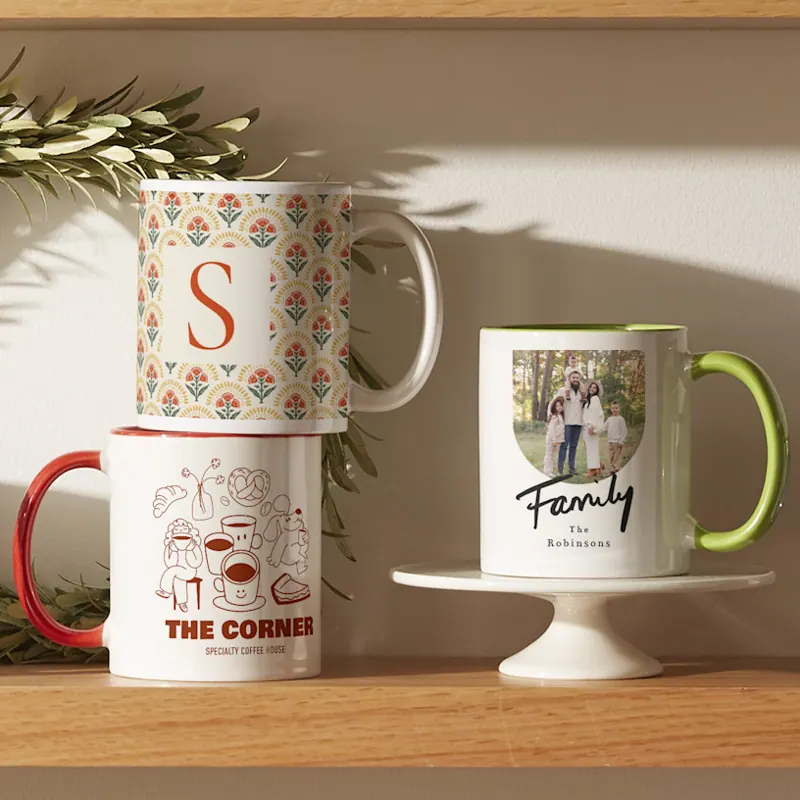
Start with the artwork, not the finish
A name, a simple symbol and a family photograph make very different demands on a decoration method. Decide which information the gift must communicate before choosing the process. If the purpose is to preserve skin tones and the color of a particular place, color reproduction is central to the idea. If the purpose is a discreet name or emblem, a simpler mark may be enough.
The CustomInk source catalog identifies decoration methods on individual models, including laser engraving, screen printing, transfer and embroidery. These labels describe the listed model’s process. They should not be treated as interchangeable options that every product supports.
What to consider for engraving
Engraving usually asks you to think in terms of lines, shapes and contrast rather than the original colors in a photograph. A clear monogram or short inscription can be easier to evaluate than a detailed family scene. A photograph may need a separate treatment before it becomes suitable engraving artwork.
Ask how the mark will appear on the selected material and finish. The name of a process alone does not establish the final contrast, depth or appearance. Review an actual proof for the selected item, and confirm whether the illustration is intended as a placement guide or as a representation of the final finish.
What to consider for printed photographs
For color work, check the supported print area, the number of printable sides and any limits on the design. A product described as screen printed may have a color limit or need a different treatment for photographic detail. A “full color” model may be better aligned with a photograph, but its exact artwork requirements still matter.
Use the original image and explain which part must remain recognizable. Avoid placing fine text over a busy face or background. If a photo has been turned into a poster-style graphic, evaluate the simplified version as a new design rather than assuming it preserves every facial detail.
Use the quotation to resolve the tradeoffs
Ask for the method, material, dimensions, quantity and artwork treatment to be written together in the quotation. The source catalog’s minimum quantity belongs to that source model; a different production arrangement can have different requirements. Do not infer a one-piece order simply because an item can be personalized.
This is a specification-based comparison, not a laboratory test of wear, fading or dishwasher performance. Those questions require the selected manufacturer’s care instructions and, when the result is critical, an appropriate physical sample. Choose the process that supports the image and the intended use, then approve the proof before production.
Start the conversation.
Share a useful tip, ask a question or tell us what matters to you.